

Description
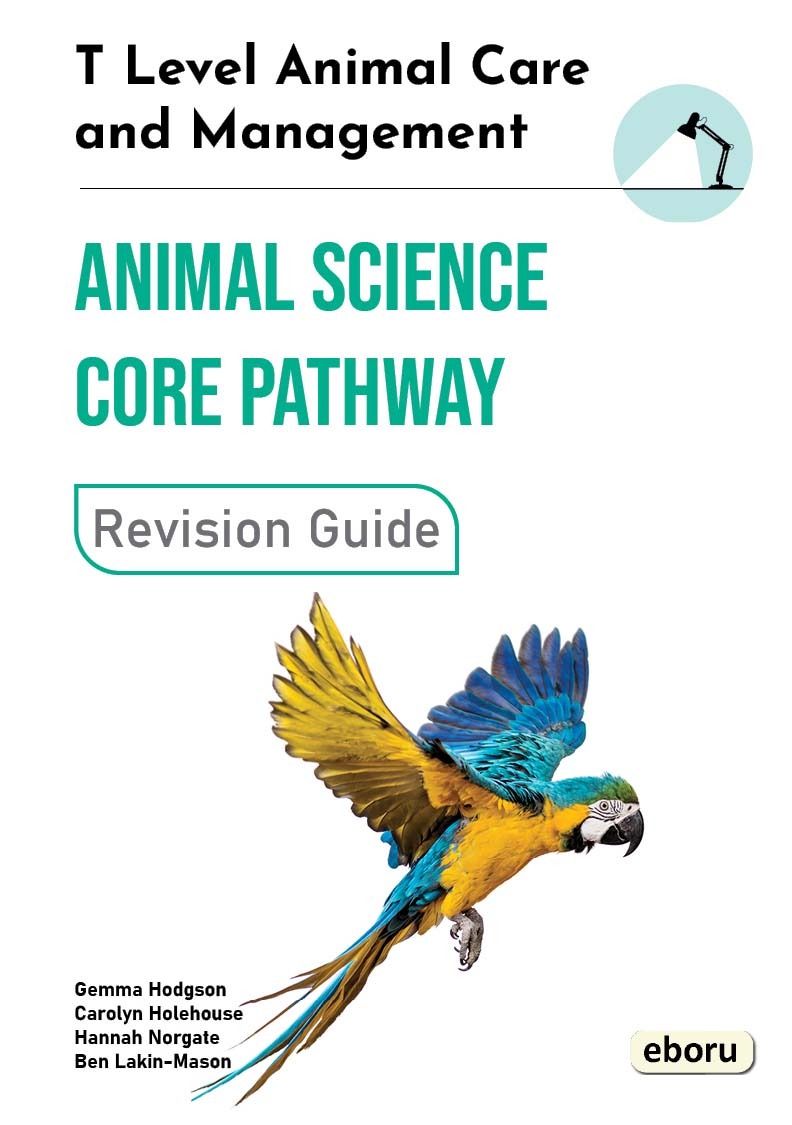
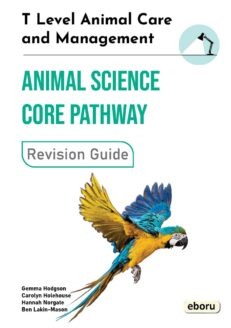
T Level Animal Science Core Pathway Revision Guide
‘T-LEVELS’ is a registered trade mark of the Department for Education and ‘T Level’ is a registered trade mark of the Institute for Apprenticeships and Technical Education (IfATE).
This Revision Guide has not been co-created with, or endorsed by, IfATE or the DfE.
—
Our T Level Animal Science Revision Guide for the T Level Animal Care and Management covers the Animal Management Core Pathway.
The contents of the book are as follows:
- Health and safety
- Sustainability
- Biosecurity
- Supply chain
- Anatomy and physiology
- Biological cells and tissues
- Nutrition
- Animal behaviour
The authors are:
- Gemma Hodgson
- Carolyn Holehouse
- Hannah Norgate
- Ben Lakin-Mason
You can also find details about the specification and assessments on the City & Guilds website.
Structure of the T Level Animal Science
The official title of the qualification is the T Level Agriculture, Environmental and Animal Care (8717). There are two routes within this T Level, one for Agriculture and one for Animal Care and Management. There is a Common Core, that is the same in both routes. Beyond that, qualifcation splits into:
- Agriculture, Land Management and Production
- Animal Care and Management
Within the Animal Care and Management pathway there are two specialisms:
- Animal Management
- Animal Science
This revision guide focuses on the T Level Animal Science Core Pathway, which has an externally set 2-hour exam, worth 80 marks.
—
What are T Levels?
T Levels are a new type of qualification in England designed for students aged 16 to 19 who want to gain practical skills and knowledge in a specific career area. They are equivalent to three A Levels and provide a mix of classroom learning and real-world experience through a substantial industry placement.
How do T Levels compare to other qualifications?
- A Levels: T Levels are Level 3 qualifications, just like A Levels. One T Level is equivalent to taking three A Levels. Whilst A Levels are classroom-based and prepare students for university study, T Levels focus on practical skills and preparation for a particular career. However – T Levels contain a mixture of practical and classroom work, and include examinations. You will also do a 45 day work placement as part of a T Level. T Levels also provide routes into university. T Levels are demanding – they are not an easier option!
- Apprenticeships: T Levels include a work placement but still involve classroom learning, whereas apprenticeships are mostly on-the-job training with some classroom-based study.
- BTECs and other vocational courses: T Levels have been designed with employers to meet specific industry needs, offering a clearer route into skilled jobs or higher education. BTEC Nationals, Cambridge Advanced Nationals, and others, are Level 3 qualifications that have a vocational flavour but they are more general than T Levels. They are primarily classroom-based qualifications.
What do you study on a T Level?
Each T Level focuses on a specific sector, such as health, digital, construction, education, or finance. The qualification includes:
- Core knowledge and skills relevant to the industry
- A work placement of at least 45 days with an employer
- Specialist training in an area of the chosen sector
What can you do after a T Level?
T Levels are designed to lead directly into skilled employment, apprenticeships, or higher education, including university degrees. Many universities accept T Levels as part of their entry requirements, and employers value the practical experience they provide.
Who should consider a T Level?
T Levels are ideal for students who:
- Prefer a mix of practical and classroom learning
- Have a clear idea of the career sector they want to work in
- Want to gain hands-on experience with an employer
- Are looking for a qualification that can lead to work, apprenticeships, or university
If you want a qualification that gives you both knowledge and real-world experience in your chosen career, a T Level is a great choice!
Reviews
There are no reviews yet.